
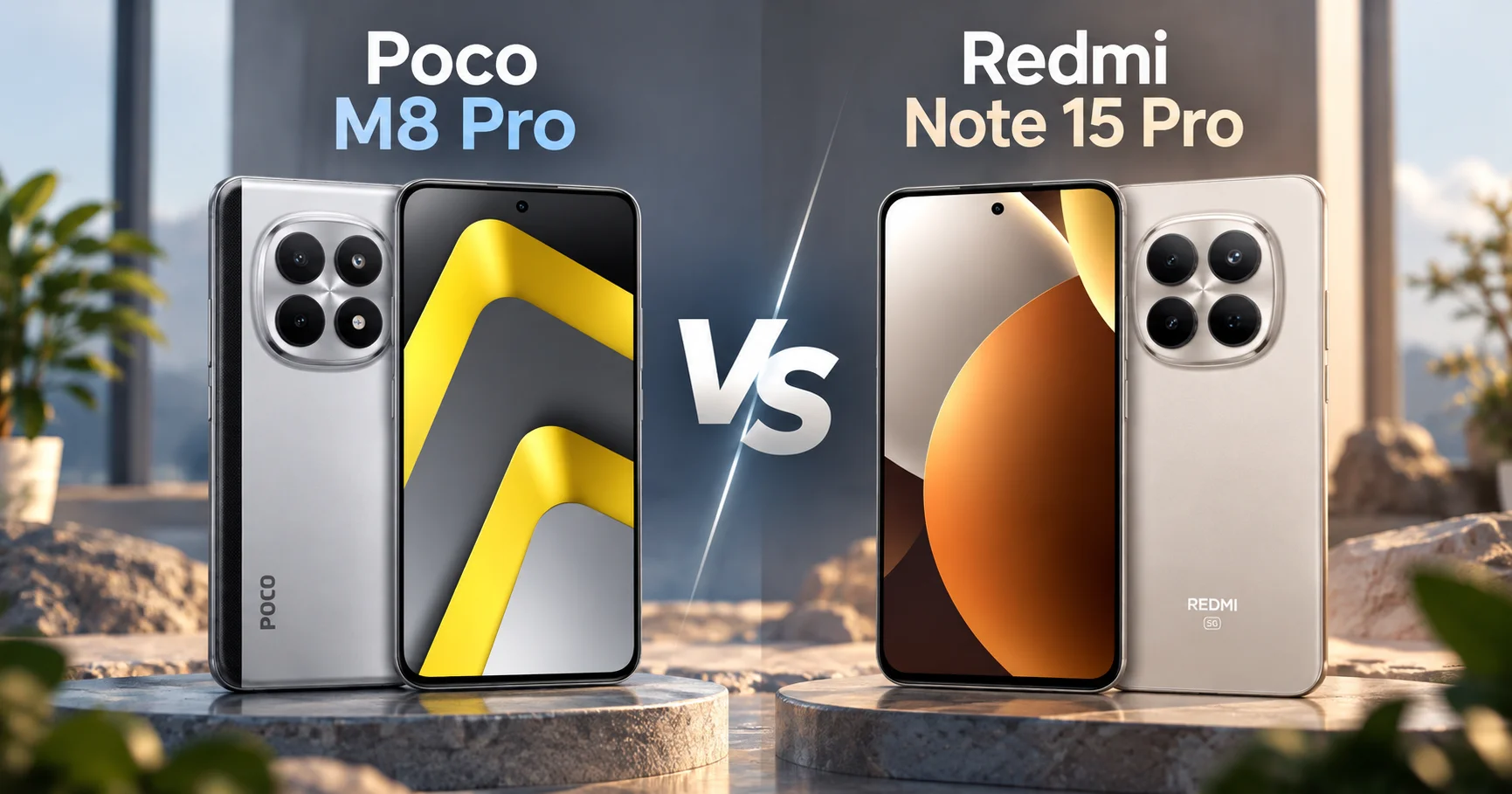
Is the Redmi Note 15 Pro worth buying, or is the Poco M8 Pro the smarter deal?
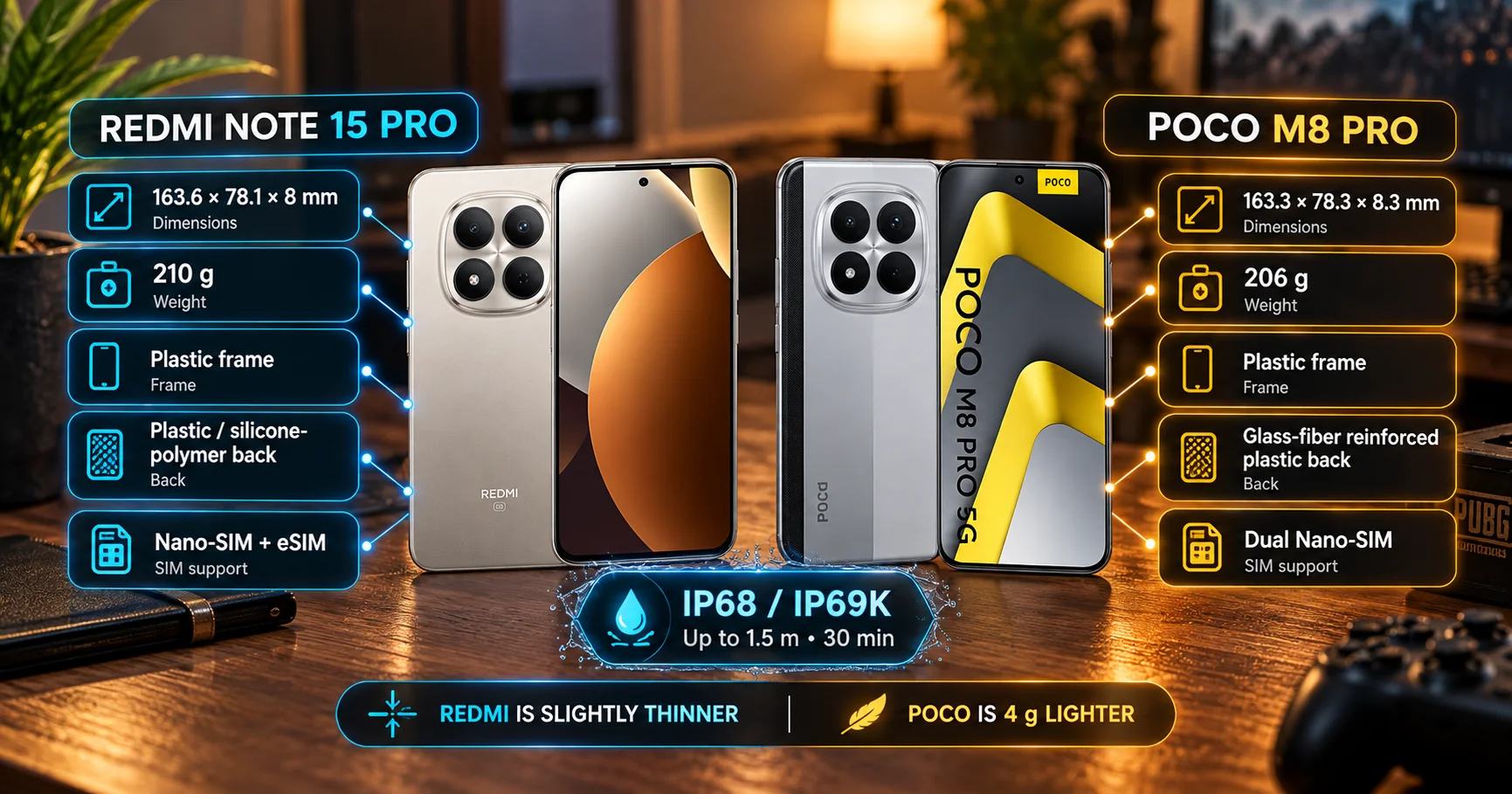
The Xiaomi Redmi Note 15 Pro measures 163.6 × 78.1 × 8 mm and weighs 210 grams, with a plastic frame and a plastic or silicone polymer back featuring a leather-like design.
The Poco M8 Pro, on the other hand, measures 163.3 × 78.3 × 8.3 mm and weighs 206 grams, with a plastic frame and a glass-fiber-reinforced plastic back.
The Poco is 4 grams lighter, while the Redmi is slightly thinner.
In terms of protection, both phones offer an advanced level of protection thanks to their IP68/IP69K certification, withstanding submersion in water up to a depth of 1.5 meters for up to 30 minutes according to the specified standards.
The Redmi also supports Nano-SIM and eSIM, while the Poco relies solely on two physical Nano-SIM cards.
Brightness reaches 1,800 nits in HBM mode and 3,200 nits at peak brightness, with a PWM dimming frequency of 3,840 Hz.
As for protection, both devices feature Corning Gorilla Glass Victus 2.
Consequently, you won’t find any significant practical differences in the basic display specifications between the two phones; both offer a suitable experience for watching videos, playing games, and browsing the web, with AMOLED colors and smooth motion thanks to the high refresh rate.
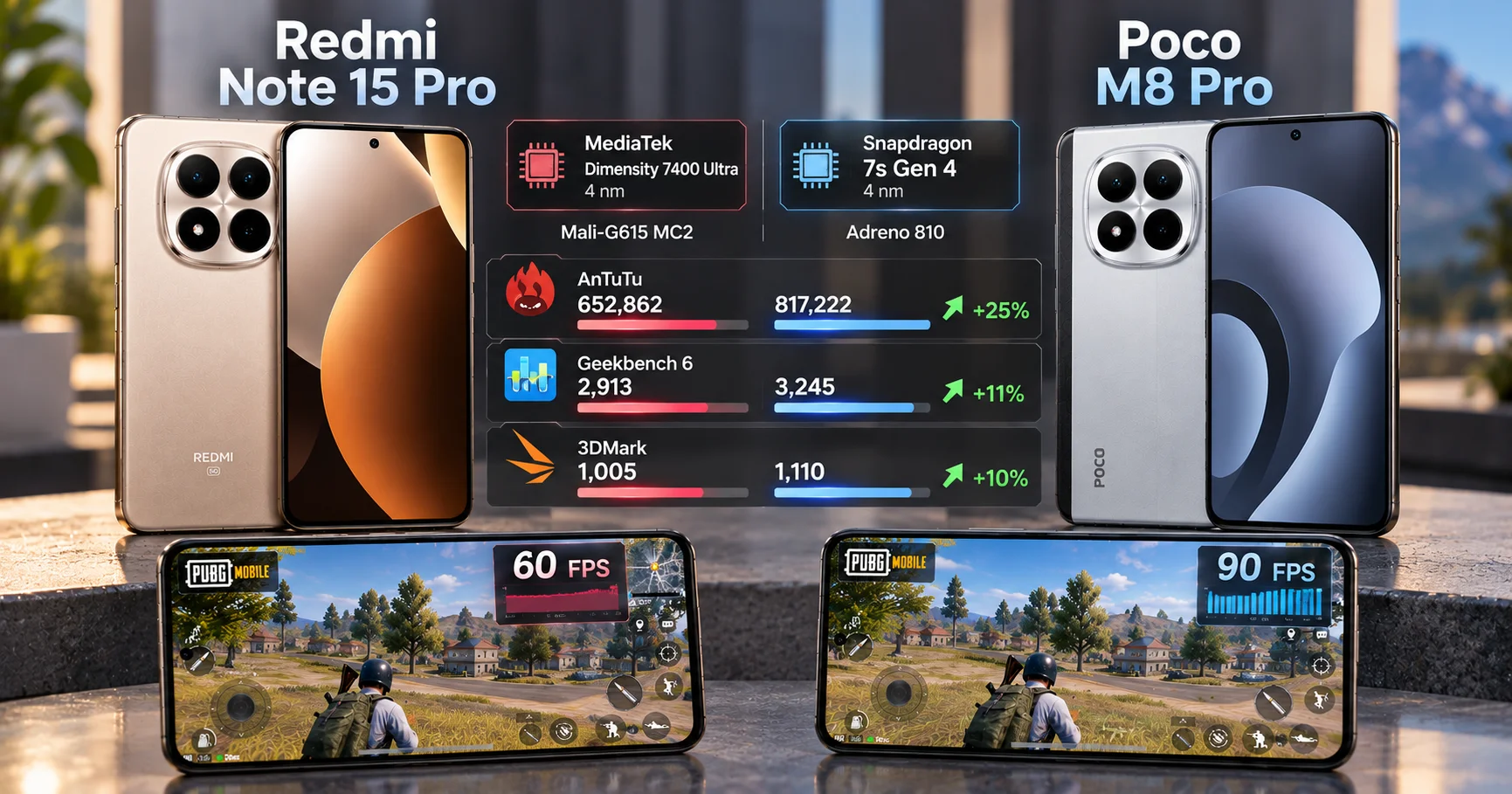
The Redmi Note 15 Pro is powered by a MediaTek Dimensity 7400 Ultra processor built on a 4-nanometer process, paired with a Mali-G615 MC2 graphics processor. In contrast, the Poco M8 Pro uses a Qualcomm Snapdragon 7s Gen 4 processor built on a 4-nanometer process, paired with an Adreno 810 GPU.
According to test results, the Poco scores higher in all three benchmarks:
*AnTuTu*: The Poco scores approximately 817,222 points, compared to 652,862 points for the Redmi—a difference of about 25%.
*Geekbench 6*: The Poco scores around 3,245 points, compared to 2,913 points for the Redmi, a difference of approximately 11%.
* 3DMark*: The Poco scores around 1,110 points, compared to 1,005 points for the Redmi.
As for PUBG Mobile, the Poco M8 Pro supports up to **90 frames per second (90 FPS)**, compared to **60 frames per second (60 FPS)** on the Redmi Note 15 Pro, giving the Poco an edge in smoothness and responsiveness during gameplay, especially in fast-paced battles.
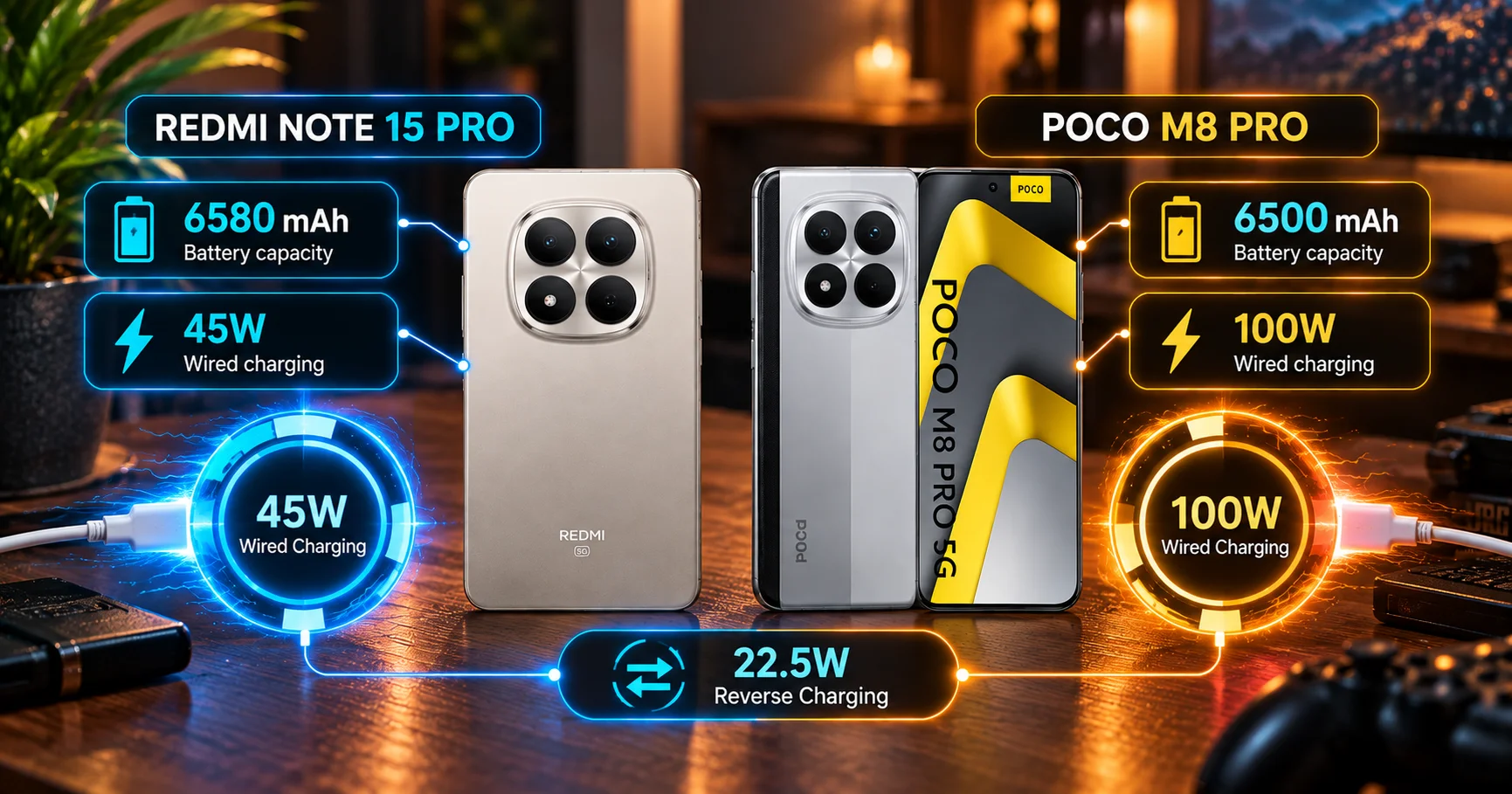
The Redmi Note 15 Pro comes with a 6,580 mAh battery, while the Poco M8 Pro has a 6,500 mAh battery.
The difference between them is only 80 mAh, meaning the battery capacities are very similar, and these numbers alone aren’t enough to judge actual battery life.
However, the major difference lies in charging speed:
Redmi Note 15 Pro: 45-watt wired charging.
Poco M8 Pro: 100-watt wired charging.
This means the Poco supports more than double the charging power, which is a significant advantage for those who don’t want to wait long while charging their phone.
Both phones also support 22.5-watt wired reverse charging.
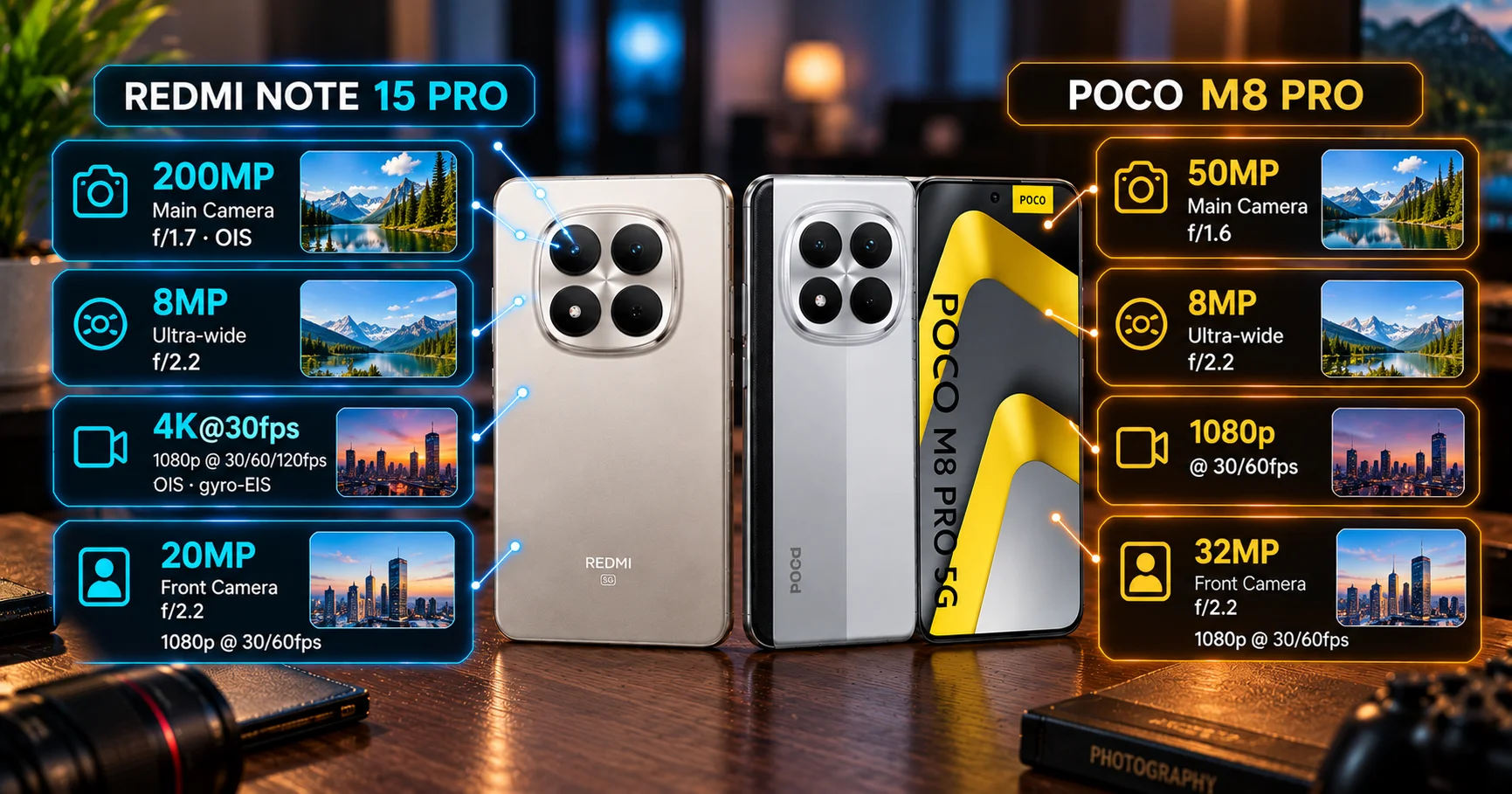
The photography philosophy differs significantly between the two phones.
The Redmi Note 15 Pro features a 200-megapixel main camera with an f/1.7 aperture and optical image stabilization (OIS), along with an 8-megapixel ultra-wide-angle camera.
The Poco M8 Pro, on the other hand, features a 50-megapixel main camera with an f/1.6 aperture, along with an 8-megapixel ultra-wide-angle camera.
The Redmi also has the edge when it comes to video recording, as it supports 4K video recording at 30 frames per second, while the Poco M8 Pro supports 1080p recording at rates of up to 120 frames per second, with OIS and gyro-EIS support.
As for the front-facing camera, the Redmi features a 20-megapixel camera, while the Poco outperforms it with a 32-megapixel camera.
Both phones support 1080p front-facing video recording, though the available frame rate options differ according to their respective specifications.
Therefore, if the rear camera and video recording are your priorities, the Redmi Note 15 Pro offers more appealing specs, while the Poco has the edge in terms of front-facing camera resolution.
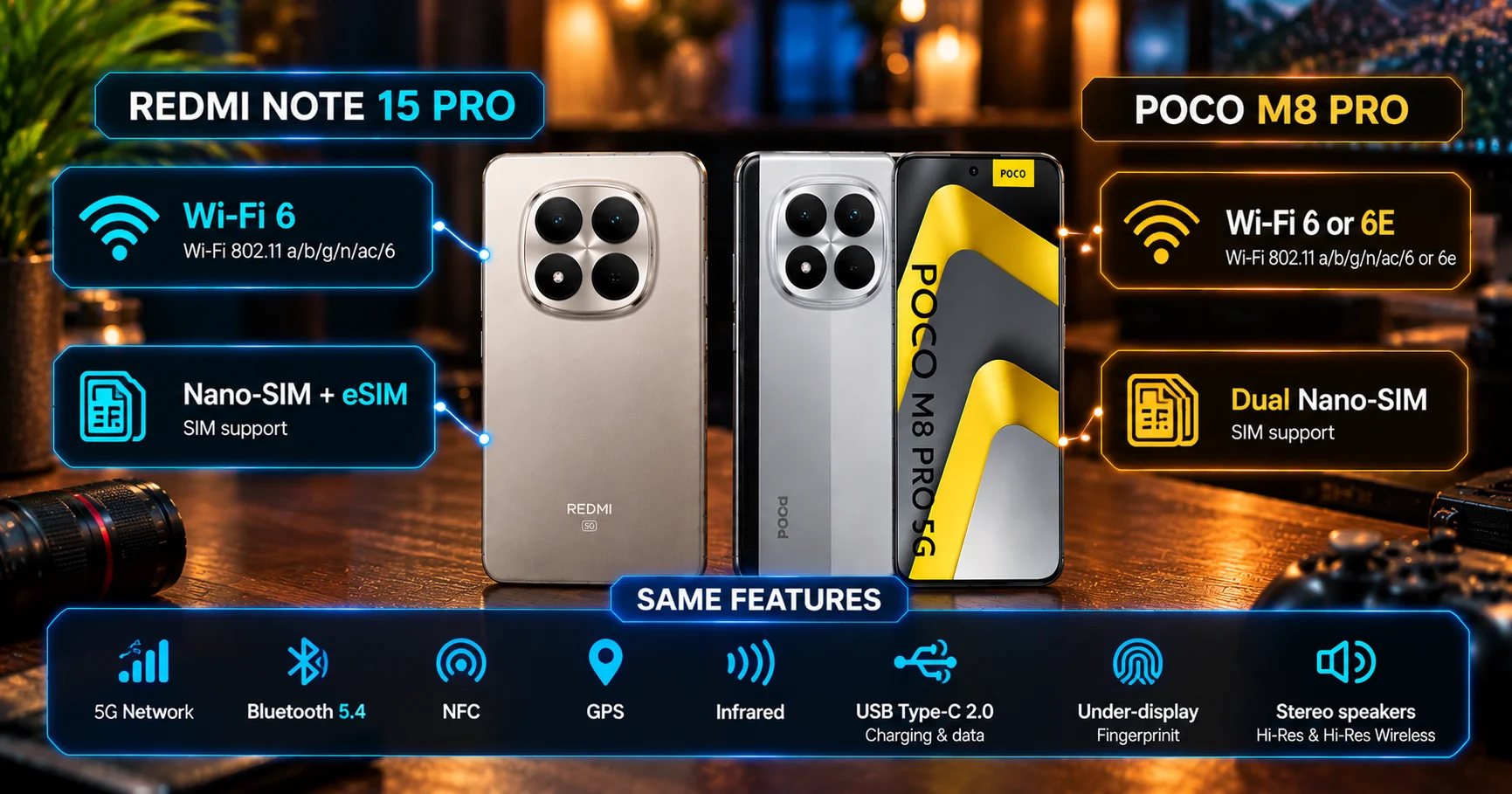
Both phones support 5G networks, Bluetooth 5.4, NFC, and GPS, as well as infrared for controlling home devices.
Both also feature Wi-Fi 6, and the Poco specifications note that they may also support Wi-Fi 6E.
Both devices use a USB Type-C 2.0 port for charging and data transfer, with an in-display fingerprint sensor.
In terms of audio, both phones offer stereo speakers and support for Hi-Res Audio and Hi-Res Wireless Audio.
Neither has a significant advantage in this area, though there is an important difference in SIM card support: the Redmi supports eSIM technology, while the Poco allows for the use of two physical SIM cards.
The Poco M8 Pro, on the other hand, is available with 8 or 12 GB of RAM, with storage options of 256 and 512 GB.
Both phones use UFS 2.2 technology for internal storage, and neither supports the addition of an external memory card.
Redmi has the edge in offering a storage option starting at 128 gigabytes, while Poco does not include this capacity among its listed options.
You’ll be giving up the Snapdragon 7s Gen 4’s superior performance in the attached benchmarks.
You’ll get 45-watt charging instead of the Poco’s 100 watts.
You’ll play PUBG Mobile at up to 60 FPS instead of 90 FPS.
You’ll get a 20-megapixel front-facing camera instead of a 32-megapixel one.
If you choose the Poco M8 Pro:
You’ll be giving up the 200-megapixel main camera found on the Redmi.
You’ll lose the ability to record 4K video with the rear camera, according to the attached specifications.
You’ll get a battery that’s 80 mAh smaller.
You won’t get the eSIM support found on the Redmi.
The 128 GB storage option won’t be available to you.
Link to buy the Redmi Note 15 ProAffiliate link: we may earn a small commission at no extra cost to you.


No comments yet — be the first to comment.